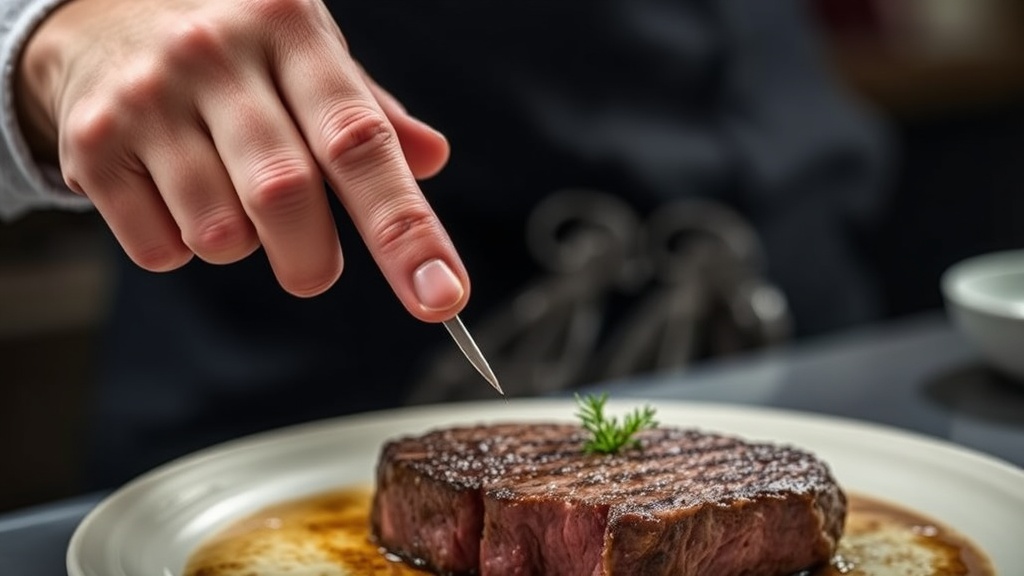
The Finger Test: Check Steak Doneness Without a Thermometer

Quick Tip
Touch your thumb to each fingertip to create different muscle tensions that match steak doneness levels—index for rare, middle for medium-rare, ring for medium, and pinky for well-done.
The finger test offers a reliable way to check steak doneness without any special equipment. Learn this technique and you'll never serve an overcooked ribeye again — even when the thermometer's dead or (let's be honest) buried in a kitchen drawer somewhere.
How Does the Finger Test Work for Steak?
The finger test works by comparing the firmness of the steak to the fleshy part of your palm below the thumb. As you cook meat, the proteins tighten and the steak becomes firmer — just like the muscles in your hand when you tense them in specific ways. It's surprisingly accurate once you get the hang of it.
Here's the technique: touch the tip of your thumb to each finger in turn. With each connection, press the fleshy base of your thumb with your opposite index finger. Each position creates a different level of firmness that corresponds to a steak's internal doneness.
- Thumb to index finger: Rare — soft and yielding, like a relaxed cheek
- Thumb to middle finger: Medium-rare — slightly firmer, with some spring
- Thumb to ring finger: Medium — noticeably firm, like the tip of your nose
- Thumb to pinky finger: Well-done — very firm, almost rigid
Now press your steak. Match the feel and you've got your answer.
Is the Finger Test as Accurate as a Meat Thermometer?
No — but it's close enough for most home cooking. A quality instant-read thermometer (the Thermapen ONE is the gold standard at around $100) will give you precise internal temperatures. The finger test gets you within 5-10 degrees. That's perfectly fine unless you're cooking for a food critic.
The catch? Thickness matters. A thin flank steak cooks differently than a two-inch-thick porterhouse. Thinner cuts are harder to test by touch alone — they cook through too quickly and don't develop that gradient from edge to center.
| Method | Accuracy | Speed | Best For |
|---|---|---|---|
| Finger test | ±10°F | Instant | Quick weeknight grilling |
| Instant-read thermometer | ±0.5°F | 2-3 seconds | Expensive cuts, precision cooking |
| Leave-in probe | ±1°F | Continuous | Reverse searing, roasts |
What Steaks Work Best with the Finger Test?
Thick cuts respond best. The finger test shines with steaks at least 1.5 inches thick — think bone-in ribeye, New York strip, or filet mignon. These cuts give you enough meat to actually feel the texture gradient and make a meaningful comparison.
Skip it for thin cuts like skirt steak or flat iron. Those are better judged by time and appearance. The Serious Eats guide to pan-seared steaks recommends using a timer for anything under an inch thick.
Ground meat? Forget the finger test entirely — that's a food safety issue. Always cook burgers to 160°F internal temp.
Pro Tips for Mastering the Touch Test
Practice on yourself first. Raw steak feels cold and flabby — nothing like your hand. As it cooks, the transformation happens fast. Here's the thing: rest your steak for five minutes before testing. A hot steak straight off the Weber Spirit II E-310 will feel firmer than it actually is.
Worth noting — everyone's hands are different. A professional chef with calloused palms might interpret "firm" differently than someone with softer skin. The first few times, use a thermometer as backup. Check the steak with your finger, then verify with the probe. After a dozen steaks, you'll trust your thumb.
One final note on technique: press gently in the center of the steak, not the edges. Edges cook faster and will mislead you. And don't poke repeatedly — every puncture lets precious juices escape.
Master this method and you'll grill with confidence anywhere. Beach barbecue. Campsite cooking. That friend's apartment with the terrible electric stove. The finger test travels light.